The Great Agentic Simplification: Why Enterprises Are Abandoning Multi-Agent Webs for Portable Skills
Production latency, compounding token costs, and context-handoff failures are driving enterprise engineering leaders away from sprawling multi-agent orchestration topologies toward consolidated single-agent runtimes gove
Test the strategic choices, STEEP drivers, and regional contagion paths from this brief inside the Scenario Decision Emulator or the 3D Global Signal Map.
Production latency, compounding token costs, and context-handoff failures are driving enterprise engineering leaders away from sprawling multi-agent orchestration topologies toward consolidated single-agent runtimes governed by open skill standards. In October 2026, Anthropic PBC formally donated its Agent Skills specification to the Linux Foundation Agentic AI Foundation while releasing enterprise migration toolkits that advise organizations to collapse brittle sub-agent graphs into context-loading primary agents. Across Fortune 500 technology environments, the first wave of experimental multi-agent swarms has collided with hard production economics: every autonomous handoff between specialized sub-agents multiplies inference latency, expands the non-human identity attack surface, and degrades reasoning fidelity across serialization boundaries.
For Chief Information Officers, Chief Information Security Officers, and Vice Presidents of Engineering, this architectural correction alters how enterprise artificial intelligence budgets should be allocated through 2027. Rather than funding custom orchestration middleware that binds business logic to proprietary multi-agent frameworks, enterprise buyers are standardizing on portable, declarative skill packages that a single primary model loads dynamically on demand. Simultaneously, security platform consolidation, underscored by Microsoft Corporation introducing Project Perception with Microsoft 365 E7, Proofpoint, Inc. acquiring Varonis Systems, Inc. for $6.3 billion, and Cyera acquiring Oasis Security for $1 billion, forces engineering teams to minimize the number of privileged machine identities operating inside corporate networks.
Key Insights Summary
| Architectural Dimension | Legacy Multi-Agent Webs (2024 to 2025) | Consolidated Single-Agent + Portable Skills (2026+) | Enterprise Impact |
|---|---|---|---|
| Orchestration Topology | Autonomous router and 4 to 10 sub-agents passing JSON messages | Single frontier model dynamically loading declarative skill files | Eliminates inter-agent serialization loss and routing loops |
| Inference Latency & Cost | 3x to 6x token multiplier from repeated system prompt and context re-ingestion | Linear token scaling via progressive disclosure of skill instructions | Reduces production inference spend by 40 percent to 65 percent |
| Security & Identity Surface | Proliferating non-human credentials per sub-agent across databases and APIs | Single auditable principal monitored by runtime containment engines | Aligns with Microsoft Project Perception and unified DSPM controls |
| Vendor Portability | Tight coupling to framework-specific state graphs and proprietary APIs | Open Linux Foundation Agent Skills standard across runtimes | Protects enterprise workflow IP across Anthropic, OpenAI, and Google Cloud |
Why Multi-Agent Orchestration Webs Fail in Enterprise Production
Sprawling multi-agent architectures fail in enterprise production because inter-agent communication introduces compounding context loss, unpredictable latency, and unmanageable non-human identity sprawl. During early enterprise proofs of concept, engineering teams mirrored human organizational charts by splitting tasks across planner agents, researcher agents, coder agents, and reviewer sub-agents. While this separation of concerns compensated for the narrow context windows and shallow instruction-following capabilities of earlier foundation models, frontier models released in 2026 by Anthropic PBC and OpenAI sustain coherent multi-step reasoning across hundreds of thousands of tokens within a single execution loop.
When an enterprise workflow dispatches a request across five autonomous sub-agents, each handoff requires serializing intermediate state into natural language or structured schemas. If each agent in a five-node chain achieves 92 percent task fidelity, end-to-end workflow reliability drops to 65.9 percent before accounting for tool-call timeouts or API rate limits. In addition, every sub-agent invocation re-transmits overlapping conversation history and schema definitions, inflating enterprise token bills without improving output accuracy. By releasing migration kits in October 2026 that guide engineering teams back to single primary agents with on-demand context loading, Anthropic PBC validated what production telemetry already showed: consolidation outperforms fragmentation whenever a task fits within a single model's reasoning horizon.
How the Linux Foundation Agent Skills Standard Restores Workload Portability
Standardizing workflow logic into declarative Agent Skills decouples enterprise domain expertise from underlying foundation model vendors and cloud hyperscalers. In October 2026, Anthropic PBC transferred stewardship of the Agent Skills specification to the Linux Foundation Agentic AI Foundation following adoption across developer platforms including Cursor, GitHub Copilot, and ChatGPT. At the same time, OpenAI expanded beyond single-cloud exclusivity by integrating its GPT-6 frontier models (Astra, Sol, and Luna) and Codex agentic coding workflows directly into Google Cloud Model Garden.
When foundation models become interchangeable across hyperscaler clouds, locking institutional knowledge inside proprietary orchestration code creates avoidable switching costs. The Agent Skills standard packages domain instructions, deterministic verification scripts, and tool-invocation runbooks into modular directory structures using progressive disclosure. Only a compact metadata description sits in the primary agent's active context window until a specific task triggers the full skill file. Enterprise engineering teams at manufacturing, financial services, and healthcare institutions can author a compliance audit skill or an enterprise resource planning reconciliation skill once, commit it to version control, and execute it identically whether the underlying inference engine runs on Anthropic Claude, OpenAI Codex on Google Cloud, or on-premises open-weights hardware.
Why Non-Human Identity Consolidation Mandates Fewer Autonomous Principals
Reducing the number of active sub-agents directly lowers enterprise breach exposure as attackers target autonomous machine credentials and network orchestration layers. In October 2026, Microsoft Corporation unveiled Project Perception alongside Microsoft 365 E7, reclassifying autonomous AI agents as privileged insiders rather than static software utilities. Project Perception deploys automated Guardian Agents to investigate permission drift and continuously risk-score more than 60 agent types across enterprise environments.
Capital markets activity during the same October 2026 window underscores the urgency of governing machine access to corporate data. Proofpoint, Inc. entered a definitive $6.3 billion agreement to acquire data security leader Varonis Systems, Inc., while data security posture management provider Cyera raised $400 million at a $12 billion valuation and acquired non-human identity specialist Oasis Security for $1 billion. Simultaneously, the Cybersecurity and Infrastructure Security Agency (CISA) added critical privilege escalation and command injection flaws (CVE-2026-114625 in Arista VeloCloud Orchestrator and CVE-2026-110447 in Collabora Online CODE servers) to its Known Exploited Vulnerabilities Catalog on October 23, 2026. When an enterprise replaces a ten-agent mesh with a single primary agent executing deterministic Python verification scripts and modular skills, the security operations center reduces its non-human identity footprint by 90 percent. Auditing one primary agent principal against Varonis or Cyera data lineage policies is operationally tractable; auditing dynamic permission delegation across recursive sub-agent swarms introduces blind spots that static identity tools cannot resolve.
How Sovereign Compute and Export Controls Constrain Agent Topologies
Physical power bottlenecks and model-level export controls penalize compute-heavy multi-agent architectures across multinational deployments. In October 2026, the United States Department of Commerce expanded export control enforcement beyond semiconductor hardware to frontier model weights by issuing an Is-Informed Letter restricting specific advanced model variants, concurrent with extraterritorial general-purpose AI and transparency enforcement under the European Union AI Act (Regulation (EU) 2026/1744). On the physical infrastructure side, Amazon.com, Inc. partnered with X-energy Reactor Company, LLC and American Electric Power Company, Inc. to build 960 megawatts of small modular reactor capacity in Indiana toward its 5-gigawatt nuclear goal, while Agility Robotics, Inc. committed its Digit 5 humanoid fleet to NVIDIA IGX Thor edge modules backed by over $300 million in commercial orders.
These regulatory and physical constraints mean enterprise compute is neither infinitely elastic nor globally uniform. A multinational corporation running latency-sensitive manufacturing or financial workflows across North America, Europe, and Asia cannot rely on chatty multi-agent topologies that consume five times the megawatt-hours and cross-border API calls of a consolidated agent. If an export control directive or European Union compliance gate restricts a frontier model tier in a specific jurisdiction, a single-agent architecture using portable skills can swap its underlying model endpoint to an approved regional model without rewriting orchestration graphs.
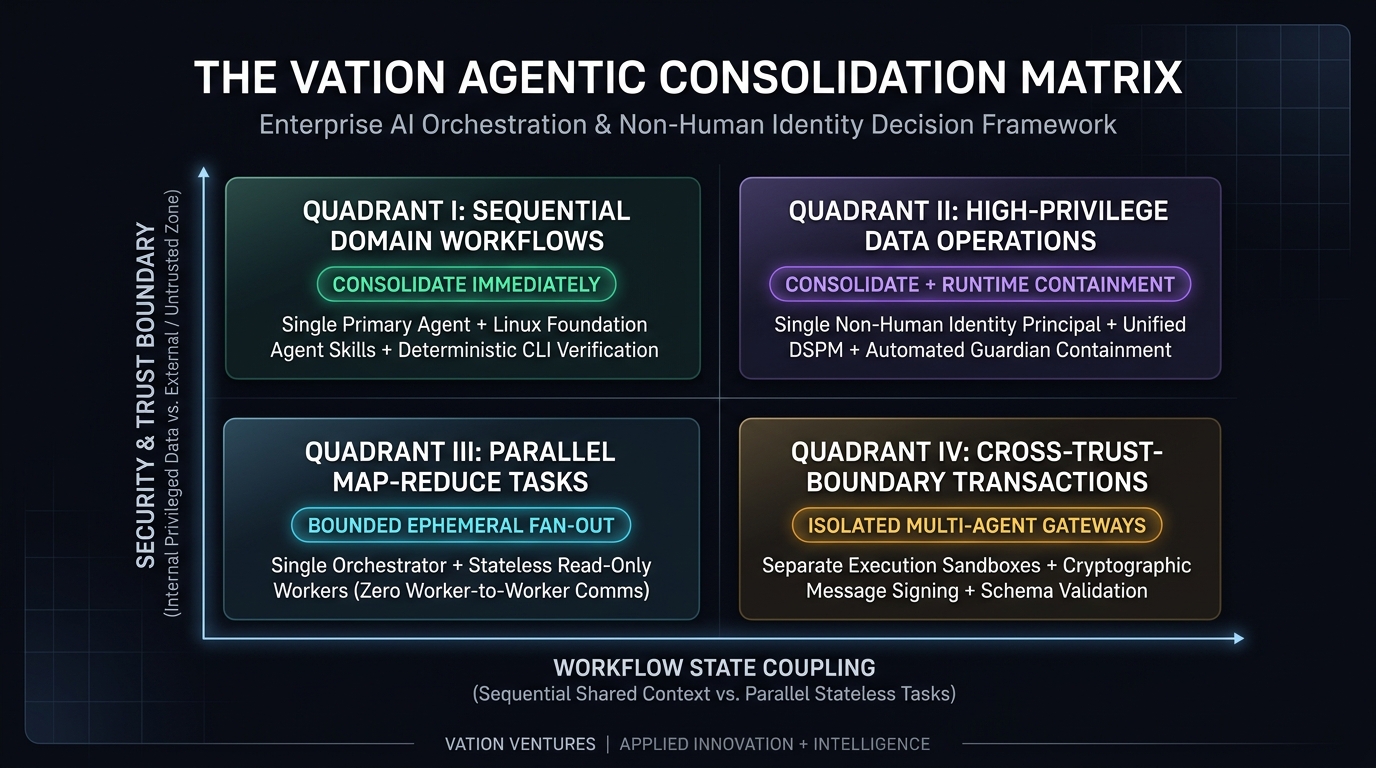
The Vation Agentic Consolidation Matrix
To help Chief Information Officers and Chief Architects decide when to collapse multi-agent systems into a single primary agent with portable skills versus when isolated sub-agents remain justified, Vation Ventures developed the Vation Agentic Consolidation Matrix. External analysts and enterprise architecture review boards can apply this four-quadrant decision model across their AI portfolios:
- Quadrant I: Sequential Domain Workflows (Consolidate Immediately)
- Characteristics: Multi-step research, code generation, financial reporting, or compliance auditing where steps share common source documents and execute sequentially.
- Architectural Prescription: Collapse all sub-agents into a single primary agent equipped with Linux Foundation Agent Skills and deterministic CLI verification scripts.
- Quadrant II: High-Privilege Data Operations (Consolidate + Enforce Runtime Containment)
- Characteristics: Workflows querying regulated customer records, intellectual property repositories, or enterprise resource planning ledgers.
- Architectural Prescription: Enforce a single non-human identity principal governed by unified Data Security Posture Management (such as Proofpoint-Varonis or Cyera) and monitored by runtime investigators (such as Microsoft Project Perception).
- Quadrant III: Embarrassingly Parallel Map-Reduce Tasks (Bounded Ephemeral Fan-Out)
- Characteristics: High-volume batch processing where 50+ independent documents or repositories must be analyzed simultaneously with zero cross-task state sharing.
- Architectural Prescription: Retain a single orchestrator that dispatches stateless, read-only worker calls in parallel, prohibiting worker-to-worker communication or write permissions.
- Quadrant IV: Cross-Trust-Boundary Transactions (Isolated Multi-Agent Gateways)
- Characteristics: B2B negotiations, supply chain bidding, or zero-trust verification where two agents represent distinct legal entities or mutually untrusted security zones.
- Architectural Prescription: Maintain strict multi-agent isolation across separate execution sandboxes with cryptographic message signing and deterministic schema validation at the boundary.
Strategic Recommendations for Technology Executives
Enterprise technology leaders should execute a three-step architectural realignment over the next 90 days to capture the efficiency and security gains of agentic consolidation:
- Conduct an Orchestration Tax Audit: Direct engineering teams to measure the ratio of orchestration overhead tokens to final output tokens across all production AI workflows. Any workflow exceeding a 3-to-1 overhead ratio without a Quadrant III or Quadrant IV justification should be refactored into a single-agent skill package.
- Mandate Open Skill Packaging in Vendor Contracts: Require internal platform teams and external systems integrators to deliver agentic workflows in the Linux Foundation Agent Skills format rather than proprietary orchestration code, ensuring direct portability across Anthropic, OpenAI, and Google Cloud Model Garden runtimes.
- Unify Non-Human Identity and Data Lineage Controls: Align Chief Information Security Officer and Chief Information Officer roadmaps by binding every consolidated agent principal to continuous runtime risk scoring and data posture governance before authorizing production write access.
Vation Ventures' Applied Innovation + Intelligence team helps enterprise technology executives benchmark agentic architectures, rationalize AI security stacks, and deploy portable skill frameworks into production.
Share or simulate this intelligence brief
← Back to Thought Leadership