The Asymmetric Opt-Out: Why the New Universal AI Training Standard Fragments Search and Grounding
The joint adoption of a universal web training opt-out standard by the four dominant artificial intelligence providers creates an operational dilemma for enterprise brand owners, publishers, and corporate general counsel
Test the strategic choices, STEEP drivers, and regional contagion paths from this brief inside the Scenario Decision Emulator or the 3D Global Signal Map.
The joint adoption of a universal web training opt-out standard by the four dominant artificial intelligence providers creates an operational dilemma for enterprise brand owners, publishers, and corporate general counsel. On November 1, 2026, Google LLC, Microsoft Corporation, OpenAI, and Anthropic PBC jointly announced support for a standardized policy token developed within the Internet Engineering Task Force AIPREF working group, designed to allow webmasters to declare a single rule group in robots.txt that opts their content out of foundation model training. While this initiative simplifies crawler governance after two years of fragmented crawler user-agent strings, it conceals a dangerous architectural divergence: Google LLC treats the token as an all-or-nothing exclusion that removes content from both Gemini training and generative search grounding, whereas Microsoft Corporation separates training ingest from real-time grounding, allowing Microsoft Copilot to cite opted-out domains unless administrators configure separate restrictions.
For Chief Digital Officers, Chief Marketing Officers, and corporate legal leaders, this divergence dismantles the assumption that content protection and discovery visibility can be managed through a single switch. In an enterprise environment where generative engines increasingly intermediate B2B buyer journeys, opting out of foundation model scraping under Google LLC's implementation results in commercial invisibility across AI-generated overviews. Conversely, permitting ingestion under Microsoft Corporation's model protects citation volume while exposing technical documentation and research assets to competitors' pre-training pipelines. As frontier model providers scale infrastructure spending, evidenced by Anthropic PBC's updated Form S-1 registration statement disclosing $895.4 billion in total cloud commitments ahead of its proposed Nasdaq listing, the commercial pressure to harvest public web data has never been higher. Enterprise brand owners can no longer afford binary, sitewide opt-outs that fail to distinguish proprietary intellectual property from public customer acquisition channels.
Key Insights Summary
| Governance Dimension | Google LLC Gemini Policy | Microsoft Corporation Copilot Policy | Enterprise Impact |
|---|---|---|---|
| Opt-Out Token Scope | Coupled: blocks model training and search application grounding | Decoupled: blocks model training while preserving citation grounding | Creates asymmetric discovery across enterprise search engines |
| Crawler Mechanism | Combined Google-Extended and universal AIPREF policy evaluation | Independent evaluation across Bing indexers and Copilot agents | Requires separate header directives for enterprise web properties |
| Impact on Inbound Traffic | Total removal from AI Overviews and conversational summaries | Continued citation presence with source links in conversational answers | Brand owners risk structural traffic loss if opting out globally |
| Compliance & Legal Standing | Direct adherence to Internet Engineering Task Force AIPREF draft specifications | Policy alignment with European Union AI Act copyright opt-out mandates | Enforces localized legal review for multinational web portals |
Why the Internet Engineering Task Force Standard Created an Asymmetric Discovery Trap
The Internet Engineering Task Force AIPREF working group standard created an asymmetric discovery trap because participating hyperscalers chose incompatible interpretations of what opting out of training means for real-time retrieval. When webmasters deploy the universal token (_usageai-training), they intend to prevent frontier lab scrapers from absorbing proprietary research, product manuals, and editorial archives into permanent parameter weights. However, Google LLC maps this directive to the behavior of its legacy Google-Extended user agent. Under this enforcement model, any Uniform Resource Locator that excludes generative model training is automatically disqualified from participating in Google Gemini answer generation, including search summary cards that dominate high-intent commercial queries.
In contrast, Microsoft Corporation established an architectural firewall between offline model pre-training and online retrieval-augmented generation. When Microsoft Bing crawlers encounter the universal opt-out token, the indexing pipeline marks the underlying text as restricted from future model training batches, but retains the document within the live semantic retrieval index. As a consequence, when an enterprise buyer queries Microsoft Copilot for enterprise software recommendations, the engine can retrieve, summarize, and cite the opted-out company's product specifications. This fundamental divergence means that applying a single robots.txt policy across an entire corporate domain produces contradictory outcomes across the two largest corporate search ecosystems.
How Enterprise AI Buyers Are Exploiting Asymmetric Web Ingestion
Corporate procurement teams and enterprise buyers are shifting their research workflows into conversational interfaces, accelerating the penalty for companies that disappear from generative search grounding. Recent corporate buying surveys indicate that enterprise technology evaluators increasingly bypass traditional search result pages in favor of structured prompts submitted to OpenAI ChatGPT, Anthropic PBC Claude, and Google Gemini to generate vendor comparison tables and compliance checklists. If a business-to-business vendor implements a blanket training opt-out to protect its intellectual property, Google Gemini completely strips that vendor from its comparative synthesis, handing commercial advantage to competitors who leave their public product documentation accessible to AI indexers.
This dynamic coincides with growing corporate pushback against long-term frontier model spending commitments. As Anthropic PBC's SEC Form S-1 disclosures show, frontier labs have signed astronomical infrastructure deals, including Anthropic's $121.3 billion commitment with Google LLC and broader multi-cloud agreements spanning Amazon.com, Inc. and Microsoft Corporation. Enterprise buyers are refusing to rubber-stamp automatic budget increases, demanding that AI vendors prove concrete return on investment before renewing contracts. When enterprise buyers use AI agents to evaluate software vendors, they rely on models that synthesize real-time web documentation. Vendors that vanish from generative grounding due to defensive robots.txt policies eliminate themselves from buyer shortlists before human sales conversations occur.
Why Infrastructure Hardware Chokepoints Accelerate Data Ingestion Pressures
Hardware supply chain bottlenecks in advanced semiconductor packaging are driving foundation model providers to maximize the data efficiency of every training run. In early November 2026, NVIDIA Corporation finalized multibillion-dollar agreements across six critical supply chain partners, including expanding interposer wafer capacity with Amkor Technology, Inc. in South Korea by 300 percent through 2028 and committing $1.1 billion to King Yuan Electronics Co., Ltd. for domestic semiconductor testing. With substrate allocations from IBIDEN Co., Ltd., Samsung Electro-Mechanics Co., Ltd., and Unimicron Technology Corporation remaining constrained, model developers cannot simply scale parameter counts indefinitely to achieve reasoning gains. They must feed existing accelerator clusters higher-quality, domain-specific enterprise data.
Simultaneously, the physical power required to train frontier models has forced hardware vendors and hyperscalers to pursue unconventional energy assets, including early November feasibility studies by NVIDIA Corporation to convert decommissioned nuclear power plant footprints into dedicated AI data centers to secure existing electrical grid interconnects. Because compute capacity and physical megawatts are bounded, frontier labs are aggressive about ingesting high-value enterprise text before copyright restrictions tighten. Concurrently, security risks continue to compound across enterprise infrastructure. On October 30, 2026, the Cybersecurity and Infrastructure Security Agency (CISA) added Ivanti Connect Secure vulnerabilities CVE-2026-111357 and CVE-2026-118527 to its Known Exploited Vulnerabilities Catalog following nation-state exploitation targeting Active Directory databases and BitLocker recovery keys. In an environment where infrastructure is constrained and perimeters are contested, enterprise leadership must treat web-facing data policies as a primary vector of strategic risk.
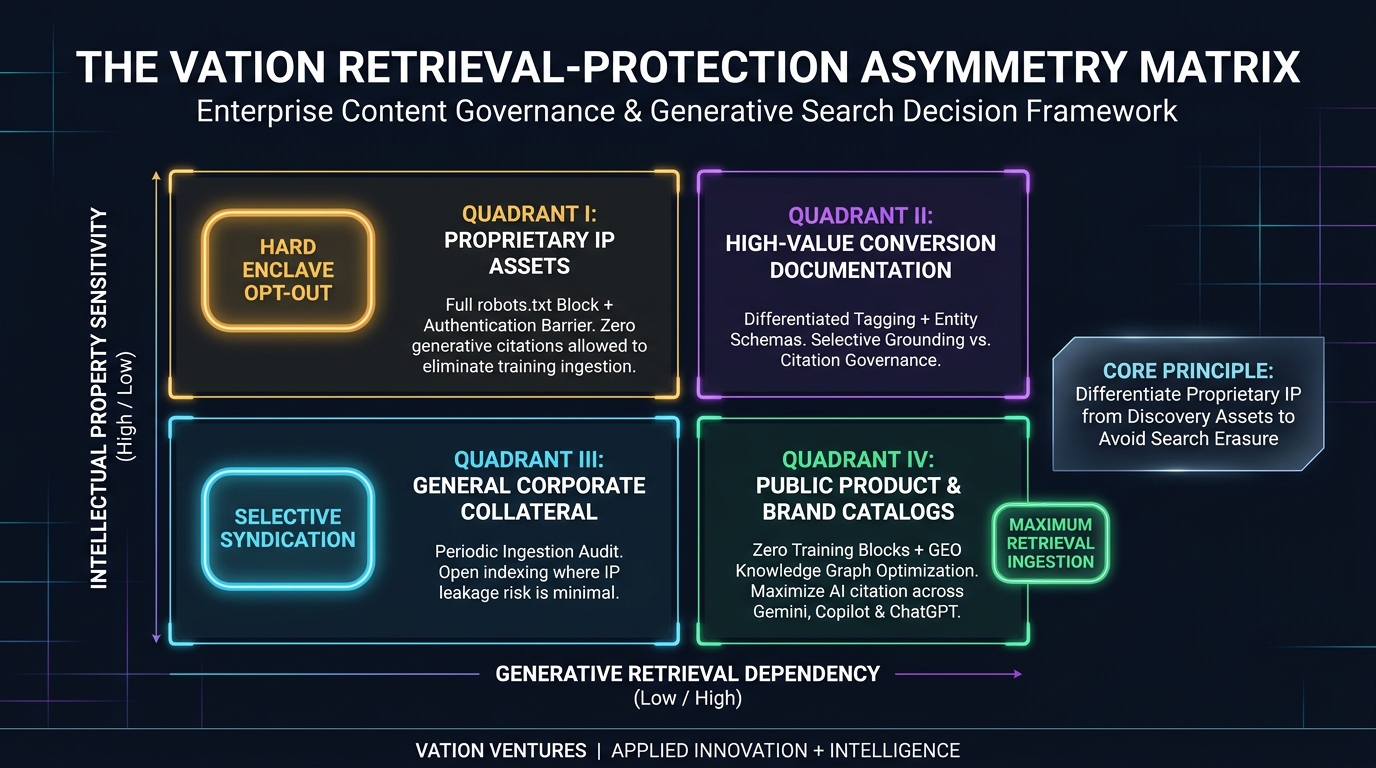
The Vation Retrieval-Protection Asymmetry Matrix
To assist Chief Information Officers, Chief Digital Officers, and General Counsel in balancing intellectual property protection against generative search visibility, Vation Ventures established the Vation Retrieval-Protection Asymmetry Matrix. External architecture review boards and corporate policy committees can apply this four-quadrant decision framework across their digital asset portfolios:
- Quadrant I: Proprietary Intellectual Property Assets (Hard Enclave Opt-Out)
- Asset Classes: Internal engineering specifications, proprietary benchmark data, customer case records, and unpatented methodology papers.
- Architectural Action: Apply strict
robots.txtexclusion via the universal AIPREF token, enforced behind mandatory authentication barriers and Zero-Trust access gateways. Accept total exclusion from Google Gemini and Microsoft Copilot retrieval to ensure zero ingestion into frontier model training sets.
- Quadrant II: High-Value Conversion Documentation (Asymmetric Governance Gate)
- Asset Classes: Detailed product architecture guides, implementation documentation, technical white papers, and total cost of ownership calculators.
- Architectural Action: Deploy differentiated header policies. Permit indexing on public technical pages while utilizing granular Schema.org semantic graphs to anchor brand assertions. Coordinate with legal counsel to accept Microsoft Copilot citations while monitoring Google AI Overview inclusion.
- Quadrant III: General Corporate Collateral (Selective Syndication)
- Asset Classes: Corporate social responsibility disclosures, executive leadership biographies, historical press statements, and investor relations transcripts.
- Architectural Action: Maintain permissive crawler access without specialized protection tokens. The competitive risk of model ingestion across these materials is negligible, whereas the discovery value for corporate reputation and recruiting remains substantial.
- Quadrant IV: Public Product and Brand Catalogs (Maximum Retrieval Ingestion)
- Asset Classes: Feature comparison matrices, public pricing tiers, API endpoint definitions, and customer review summaries.
- Architectural Action: Explicitly authorize crawling for all foundation models. Implement Generative Engine Optimization (GEO) structural tags to maximize citation frequency and accuracy across Google Gemini, Microsoft Copilot, OpenAI ChatGPT, and Anthropic Claude.
Executive Action Plan for Corporate Leadership
Enterprise leadership must execute three tactical mandates over the next 45 days to resolve the retrieval-protection asymmetry across their digital footprint:
- Conduct a Digital Asset Classification Audit: Convene digital marketing, IT security, and legal teams to categorize every public web sub-path into the four quadrants of the Vation Retrieval-Protection Asymmetry Matrix. Eliminate blunt, domain-wide
robots.txtconfigurations that unintentionally blind generative search engines to revenue-generating product pages. - Implement Differentiated HTTP Header Directives: Configure web server edges to return selective
X-Robots-Tagheaders based on content classification, ensuring proprietary documentation blocks training ingestion while marketing landing pages remain fully indexable for conversational grounding. - Establish Continuous Generative Engine Visibility Auditing: Deploy synthetic prompt benchmarking across Google Gemini, Microsoft Copilot, and ChatGPT to monitor whether core product lines appear accurately in enterprise buyer queries, tracking citation losses caused by crawler policy adjustments.
Vation Ventures' Applied Innovation + Intelligence team works directly with corporate executives and enterprise boards to audit Generative Engine Optimization posture, evaluate AI vendor risk, and design resilient content architectures.
Share or simulate this intelligence brief
← Back to Thought Leadership