The $1 Million API Blind Spot: How "LLMjacking" and Model-Key Thefts Are Draining Enterprise Cloud Budgets
Unmonitored artificial intelligence credentials have replaced traditional virtual machine cryptojacking as the most dangerous vector for immediate corporate cloud financial loss.
Test the strategic choices, STEEP drivers, and regional contagion paths from this brief inside the Scenario Decision Emulator or the 3D Global Signal Map.
Unmonitored artificial intelligence credentials have replaced traditional virtual machine cryptojacking as the most dangerous vector for immediate corporate cloud financial loss. On November 4, 2026, Google Threat Intelligence and Mandiant issued an urgent enterprise cybersecurity advisory detailing widespread LLMjacking campaigns, where threat actors harvest exposed or poorly scoped model application programming interface keys to execute automated, high-velocity inference queries against corporate quotas. In documented enterprise intrusions, compromised credentials tied to frontier platforms like OpenAI, Anthropic PBC, and Google LLC generated unauthorized consumption spikes exceeding $1 million in billable cloud usage within a single billing weekend before internal monitoring detected the anomaly.
For Chief Information Security Officers, Chief Information Officers, and enterprise finance leaders, this emerging threat surface demonstrates the collapse of traditional boundary controls. Over the past 24 months, engineering teams rapidly provisioned static API keys to test generative prototypes across internal software tools, customer service chatbots, and automated analytics pipelines. Because corporate accounting systems treat model consumption as an operational expense billed post-hoc, an attacker who steals a developer token can route hundreds of concurrent requests through premium reasoning models without triggering standard network firewalls. As frontier labs report explosive commercial scale, highlighted by OpenAI disclosing on November 4, 2026 that enterprise contracts now drive more than 50 percent of its revenue and Anthropic PBC posting a $17 billion annualized run-rate in its amended SEC Form S-1 filings, the financial liquidity of model quotas makes corporate API accounts an irresistible target for criminal monetization.
Key Insights Summary
| Threat Dimension | Traditional Cloud Cryptojacking (2020 to 2023) | Enterprise LLMjacking (Late 2026+) | Executive Business Impact |
|---|---|---|---|
| Targeted Asset | Unallocated CPU and GPU compute instances in cloud subscriptions | High-tier token quotas on frontier model endpoints (OpenAI, Anthropic PBC, Google LLC) | Bypasses virtual machine security monitors entirely |
| Financial Drain Velocity | Gradual increase in monthly compute spend limited by core limits | Explosive consumption spikes generating $1 million in unauthorized costs in hours | Causes sudden cash flow disruption and disputed vendor invoices |
| Attacker Monetization | Direct mining of volatile cryptocurrency tokens on victim hardware | Reselling premium API access via shadow proxies or running illicit fine-tuning | High-margin criminal profit with zero hardware overhead |
| Detection & Containment | Infrastructure monitoring of host CPU spikes and container runtimes | Application-layer token velocity metering and behavioral identity baselines | Mandates joint FinOps and SecOps automated circuit breakers |
Why Unmonitored Model API Keys Create Seven-Figure Financial Liability
Static model credentials create catastrophic financial liability because enterprise billing agreements provide high, pre-approved spending ceilings without automated runtime circuit breakers. When software development teams integrate frontier models into corporate applications, they frequently embed long-lived API keys into local environment files, internal source code repositories, and continuous integration pipelines. Unlike traditional software subscriptions that charge a predictable per-seat monthly fee, foundation model providers bill strictly on token consumption. A single compromised credential linked to an enterprise account with tier-four or tier-five quota allocations permits thousands of parallel input and output tokens per minute.
When cyber threat actors obtain these credentials through infostealer malware, public code leaks, or compromised developer workstations, they do not attempt corporate extortion or data encryption immediately. Instead, they weaponize the token against high-cost reasoning models. By directing massive batches of complex prompt engineering tasks, recursive tool invocations, or synthetic dataset generation through the victim's endpoint, attackers burn through enterprise credits at maximum throughput. Because cloud invoices typically arrive weeks after billing cycles close, organizations without real-time spend anomaly detection discover the compromise only after third-party providers contact corporate finance to collect seven-figure overages.
The Mechanics of LLMjacking: How Attackers Monetize Hijacked Enterprise Quotas
Attackers monetize compromised enterprise credentials by operating shadow reverse proxies that sell cut-rate access to frontier foundation models on illicit developer forums. In the technical advisory released by Google Threat Intelligence on November 4, 2026, researchers revealed that threat groups actively automate the discovery of exposed keys across public code repositories and misconfigured cloud buckets. Once a valid key is validated, it is registered into automated proxy networks that distribute incoming customer queries across dozens of stolen corporate quotas.
The buyers of this shadow compute are often small developers, grey-market marketing operations, or adversarial actors who wish to conduct automated vulnerability research without establishing verified corporate identities. The primary criminal group captures pure margin: they collect retail subscription fees while the victimized enterprise pays the underlying hyperscaler invoice. Beyond financial arbitrage, attackers utilize compromised enterprise endpoints to bypass foundational safety filters. By abusing the enterprise trust status of corporate keys, malicious campaigns route prohibited prompts through production endpoints, exposing the victim organization to severe regulatory compliance penalties alongside direct financial destruction.
How Identity Governance and Endpoint Telemetry Neutralize Token Abuse
Neutralizing model token abuse requires uniting non-human identity management with endpoint detection and response telemetry at the runtime boundary. On November 4, 2026, Anthropic PBC announced an expanded enterprise marketplace featuring native security integrations from CrowdStrike Holdings, Inc. (Falcon Guardian AIDR), Chainguard, Inc., and Rubrik, Inc. This deployment pattern illustrates the shift from isolated API key distribution to continuous, identity-aware agent protection. Simultaneously, Microsoft Corporation rolled out Agent 365 in early November 2026, providing a centralized governance plane to track agent consumption, permissions, and operational costs across enterprise estates.
When an organization replaces static API tokens with an identity-brokered access model, developer processes must request single-use, cryptographically signed ephemeral credentials tied to verified user identities and specific project tasks. Endpoint agents like CrowdStrike Falcon Guardian continuously monitor the developer workstation for credential-access techniques, while network proxies verify that requests originating from corporate API keys match approved corporate Internet Protocol ranges and geographical boundaries. If an attacker attempts to route traffic through a compromised key from an external cloud host, the identity broker invalidates the session before an enterprise incurs billable token consumption.
The Financial Risk of Bounded Compute in an Escalating Cloud Environment
The financial consequences of unmonitored model consumption are magnified by severe supply chain constraints across semiconductor packaging and data center energy grids. In late October and early November 2026, NVIDIA Corporation executed multi-billion-dollar capacity agreements across six packaging and substrate partners, including a 300 percent interposer expansion with Amkor Technology, Inc. and a $1.1 billion testing commitment to King Yuan Electronics Co., Ltd., while Marvell Technology, Inc. agreed to acquire Lumentum Holdings Inc. for $115 billion on November 2, 2026 to control optical interconnect manufacturing. Concurrently, Google LLC signed an 890-megawatt nuclear fleet upgrade deal with Constellation Energy Corporation to ensure continuous baseload electricity for its AI infrastructure.
Because physical packaging lines, optical transceivers, and electric substation interconnects remain tightly rationed, foundation model providers cannot subsidize wasted compute. Hyperscalers enforce strict contractual language holding enterprise customers strictly liable for all API traffic authenticated by valid customer credentials, regardless of whether that traffic was authorized by corporate leadership. Simultaneously, infrastructure vulnerabilities compound operational risk. The Cybersecurity and Infrastructure Security Agency (CISA) added WordPress Core race condition flaw CVE-2026-119977 to its Known Exploited Vulnerabilities Catalog on November 3, 2026 with a mandatory November 6 remediation deadline, and warned of ongoing Ivanti Connect Secure VPN compromises (CVE-2026-111357 and CVE-2026-118527). In an environment where web-facing infrastructure is under continuous automated assault, treating model API credentials as low-risk developer utilities is a multi-million-dollar corporate blind spot.
The Vation LLMjacking Defense and Quota Containment Model
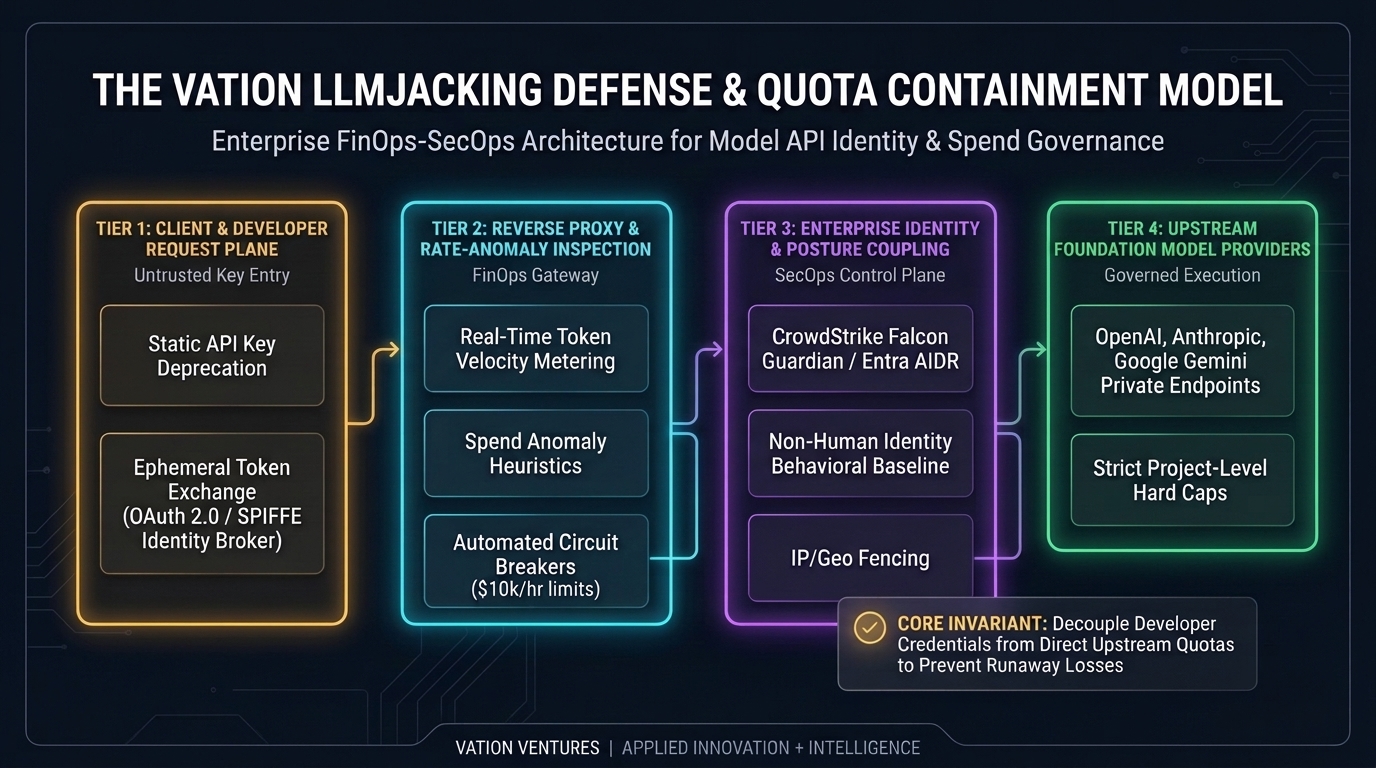
To enable technology executives and enterprise architects to eliminate model credential exposure and automate spend protection, Vation Ventures established the Vation LLMjacking Defense and Quota Containment Model. Enterprise architecture review boards and corporate security teams can implement this four-tier containment architecture across their generative environments:
- Tier 1: Client and Developer Request Plane (Untrusted Credential Entry)
- Architecture: Deprecate all static, long-lived API keys across developer laptops, local environment files, and continuous integration runners.
- Enforcement Mechanism: Mandate an identity broker that exchanges developer credentials for ephemeral tokens with a maximum lifetime of 60 minutes via OAuth 2.0 or SPIFFE identity standards.
- Tier 2: Reverse Proxy and Rate-Anomaly Inspection (FinOps Gateway)
- Architecture: Intercept all outbound model requests through an internal, highly available API gateway proxy.
- Enforcement Mechanism: Meter token velocity in real time, compare query rates against historical departmental baselines, and execute automated circuit breakers that immediately throttle or suspend accounts generating unexpected hourly spikes exceeding $10,000.
- Tier 3: Enterprise Identity and Posture Coupling (SecOps Control Plane)
- Architecture: Integrate runtime model traffic with endpoint detection telemetry and identity threat intelligence, utilizing tools like CrowdStrike Falcon Guardian and Microsoft Agent 365.
- Enforcement Mechanism: Enforce strict egress IP whitelisting, geographical fencing, and workstation device health checks. Terminate credentials instantly if requests originate from unmanaged infrastructure or known cloud hosting ranges.
- Tier 4: Upstream Foundation Model Providers (Governed Execution)
- Architecture: Route verified requests to private, dedicated enterprise endpoints across OpenAI, Anthropic PBC, and Google LLC.
- Enforcement Mechanism: Configure immutable project-level monthly hard caps directly within cloud provider billing consoles, preventing upstream vendors from processing requests once authorized budget ceilings are reached.
Executive Action Plan for CISOs and FinOps Leaders
Technology and security executives must execute three immediate remediation steps over the next 30 days to protect corporate cash flow from LLMjacking exposure:
- Conduct a Credential Discovery and Revocation Sprint: Run automated secret scanners across all corporate code repositories, configuration files, and collaboration channels to locate and revoke every exposed OpenAI, Anthropic, and Google Cloud API key. Replace standing credentials with identity-brokered access.
- Implement Real-Time Spend Anomaly Triggers: Configure cloud FinOps monitoring to track hourly model API spend velocity rather than relying on monthly reconciliation reports. Establish automated alerting and key revocation for any account exceeding 300 percent of its 7-day moving average.
- Enforce Provider-Side Hard Budget Ceilings: Log into all upstream foundation model administrative portals and set non-negotiable monthly budget caps. Require formal executive approval through corporate procurement workflows before raising quotas on any production endpoint.
Vation Ventures' Applied Innovation + Intelligence team works directly with corporate leadership, Chief Information Security Officers, and private equity operating teams to benchmark enterprise AI architectures, audit FinOps security posture, and deploy model containment controls.
Share or simulate this intelligence brief
← Back to Thought Leadership