Separating Intelligence from Authority: Why Microsoft Execution Containers Redefine Agentic Security
Enterprise artificial intelligence security crossed an architectural boundary between October 27 and October 30, 2026: technology leaders are abandoning probabilistic prompt guardrails in favor of operating-system execut
Test the strategic choices, STEEP drivers, and regional contagion paths from this brief inside the Scenario Decision Emulator or the 3D Global Signal Map.
Enterprise artificial intelligence security crossed an architectural boundary between October 27 and October 30, 2026: technology leaders are abandoning probabilistic prompt guardrails in favor of operating-system execution containers that physically separate model reasoning from system authority. During its first-quarter fiscal earnings call on October 28 to October 29, 2026, Microsoft Corporation reported $92.3 billion in quarterly revenue (a 19 percent year-over-year increase) and unveiled Microsoft Execution Containers (MXC), a policy-driven containment layer adopted by OpenAI, Anthropic PBC, and Meta Platforms, Inc. to govern autonomous agents across Windows and multi-cloud estates. Within the same 48-hour window, OpenAI embedded its frontier models and Codex coding agents directly into Oracle Corporation database and cloud applications on October 27, followed on October 28 by an expanded partnership with ServiceNow, Inc. integrating OpenAI models into the ServiceNow Super Intelligence Control Tower.
For Chief Information Security Officers, Chief Information Officers, and Enterprise Architects, these announcements expose the central flaw of first-generation artificial intelligence security. Between 2024 and mid-2026, organizations attempted to secure autonomous agents by placing natural-language filters in front of large language models while allowing the underlying agent process to hold standing database credentials and host-level execution privileges. When an autonomous agent is embedded directly inside an Oracle financial ledger or a ServiceNow IT service management workflow, a semantic filter cannot guarantee containment. Security requires decoupling intelligence (what the model proposes to do) from authority (what the operating system and database container permit the process to execute).
Key Insights Summary
| Security Dimension | First-Generation Prompt Guardrails (2024 to 2025) | Deterministic Execution Containers (October 2026+) | Enterprise Security Impact |
|---|---|---|---|
| Containment Mechanism | Probabilistic input/output text classifiers and system-prompt rules | OS-level sandboxes via Microsoft Execution Containers (MXC) | Eliminates prompt-injection privilege escalation at the kernel boundary |
| Credential Architecture | Standing API keys and shared service accounts passed into agent memory | Ephemeral, policy-brokered tokens scoped per container transaction | Prevents credential harvesting and lateral movement across systems of record |
| System-of-Record Integration | Custom middleware connectors with broad read/write database permissions | Native control planes (Oracle and ServiceNow Control Tower) | Enforces pre-existing enterprise role-based access and risk scoring |
| Audit & Compliance Posture | Application-layer chat logs vulnerable to hypervisor or kernel tampering | Out-of-band container telemetry aligned with European Commission AI Office audits | Satisfies regulatory sandbox-escape monitoring and forensic integrity |
Why Probabilistic Prompt Firewalls Fail Inside Enterprise Systems of Record
Probabilistic prompt firewalls fail in production because natural-language classifiers cannot enforce deterministic access control over database mutations and operating-system calls. When OpenAI partnered with Oracle Corporation on October 27, 2026 to embed Codex and frontier reasoning models directly into Oracle enterprise applications, and expanded its ServiceNow, Inc. integration on October 28, 2026 across the Super Intelligence Control Tower, the locus of enterprise artificial intelligence shifted permanently into core transactional systems. Simultaneously, Anthropic PBC disclosed in its late-October 2026 Form S-1 initial public offering registration statement (ticker symbol ANT) that more than 14,000 enterprise customers, including 11,900 accounts generating over $100,000 in annualized recurring revenue, now rely on Claude for multi-step corporate workflows.
At this scale of deployment, enterprise agents no longer operate as isolated chat interfaces summarizing documents. They execute structured query language mutations, provision cloud infrastructure, approve vendor invoices, and modify identity access policies. If an agent process shares the execution authority of the host server or holds a persistent service-account token, any indirect prompt injection buried inside an untrusted invoice, support ticket, or code repository can hijack the model's reasoning loop. Because large language models combine instructions and data within a single token stream, no semantic classifier can mathematically guarantee that untrusted data will not alter model intent. Treating the model itself as the policy enforcement point violates decades of computer security doctrine.
How Microsoft Execution Containers Separate Model Intent from System Authority
Operating-system execution containers resolve the agentic security paradox by treating every foundation model output as an untrusted intent proposal that must clear a deterministic kernel boundary before execution. Highlighted by Chief Executive Officer Satya Nadella during Microsoft Corporation's October 28 to October 29, 2026 earnings disclosures alongside a fivefold year-over-year surge in daily Copilot users, Microsoft Execution Containers (MXC) establish a standardized, policy-driven runtime sandbox across Windows and multi-cloud environments. Crucially, frontier model competitors including OpenAI, Anthropic PBC, and Meta Platforms, Inc. have adopted MXC to govern their own enterprise agent deployments.
Instead of allowing an autonomous agent to invoke system binaries, file systems, or network sockets directly, MXC wraps the agent runtime inside an isolated execution container governed by declarative security manifests. When an OpenAI Codex agent or an Anthropic Claude workflow formulates an action, the model emits a structured intent request rather than executing a command. The MXC policy engine intercepts that request outside the model's context window, verifies whether the requested file path, network destination, or database table matches the container's cryptographic policy manifest, and either executes the call with a single-use token or terminates the container. Even if an attacker compromises the model's reasoning through adversarial inputs, the agent possesses zero authority to act outside its pre-approved container envelope.
Why Hypervisor and Kernel Vulnerabilities Require Out-of-Band Agent Telemetry
Securing execution containers requires hardening the underlying hypervisor and operating-system kernel against privilege escalation and audit-log suppression. On October 28, 2026, the Cybersecurity and Infrastructure Security Agency (CISA) added two critical infrastructure flaws to its Known Exploited Vulnerabilities Catalog: CVE-2026-41709, an insufficient logging vulnerability in Broadcom VMware ESX that allows administrative threat actors to execute commands without generating hypervisor audit logs, and CVE-2026-46300 (tracked as Fragnesia), a Linux Kernel missing variable initialization vulnerability enabling local unprivileged users to corrupt the page cache and gain root access. These additions followed CISA's October 27, 2026 KEV alerts for Adobe Commerce (CVE-2026-48356) and Google Brotli (CVE-2026-111497), as well as the October 29, 2026 Binding Operational Directive 26-04 remediation deadline for the unauthenticated PHP2Shell remote code execution vulnerabilities (CVE-2026-109618 and CVE-2026-109619).
This convergence of active exploits illustrates why application-layer agent logging is insufficient for enterprise defense. If an uncontained AI agent or an external attacker chains a web-tier remote code execution flaw like PHP2Shell with the Linux Kernel Fragnesia privilege escalation bug (CVE-2026-46300), they can break out of standard user-space processes. Worse, if the workload runs on unpatched Broadcom VMware ESX hosts affected by CVE-2026-41709, the attacker can suppress hypervisor-level event logs to erase forensic evidence of the intrusion. This technical reality explains why the European Commission AI Office issued formal Requests for Information in late October 2026 under the European Union AI Act specifically targeting frontier model sandbox-escape monitoring. Chief Information Security Officers must pair container-level agent isolation with patched kernel substrates and out-of-band network telemetry that cannot be silenced by host-level compromise.
How Infrastructure Economics and Grid Constraints Reinforce Contained Execution
Capital market allocations and physical infrastructure deals between October 27 and October 30, 2026 demonstrate that compute efficiency and deterministic containment are economically linked. On October 28, 2026, GE Vernova Inc. signed a definitive agreement to acquire high-voltage grid equipment specialist Trench Group from Triton Partners for $9.0 billion in equity value, underscoring that high-voltage bushings and substation transformers are the physical gating factor for AI data center scaling. During the same window, Advanced Micro Devices, Inc. confirmed active production of its Helios rack-scale AI systems at Meta Platforms, Inc., Intel Corporation expanded its Xeon and Diamond Rapids partnership with Oracle Cloud Infrastructure, and heterogeneous inference provider General Compute raised a $100 million Series A round at an $800 million valuation alongside $100 million financings for Collective and Gorilla Technology Group Inc..
As Anthropic PBC's Form S-1 filing makes clear, frontier AI providers are transitioning from venture-subsidized growth to public-market margin accountability while power and grid hardware remain scarce. Uncontained agents that enter recursive retry loops, trigger runaway tool invocations, or fall into automated service loops, a failure mode targeted in late October 2026 by the New York City Department of Consumer and Worker Protection's proposed municipal AI rules, waste both expensive inference tokens and constrained data center megawatts. Execution containers like MXC and control planes like ServiceNow's Super Intelligence Control Tower enforce hard circuit breakers on compute consumption, API call velocity, and execution duration, protecting both enterprise cloud budgets and infrastructure stability.
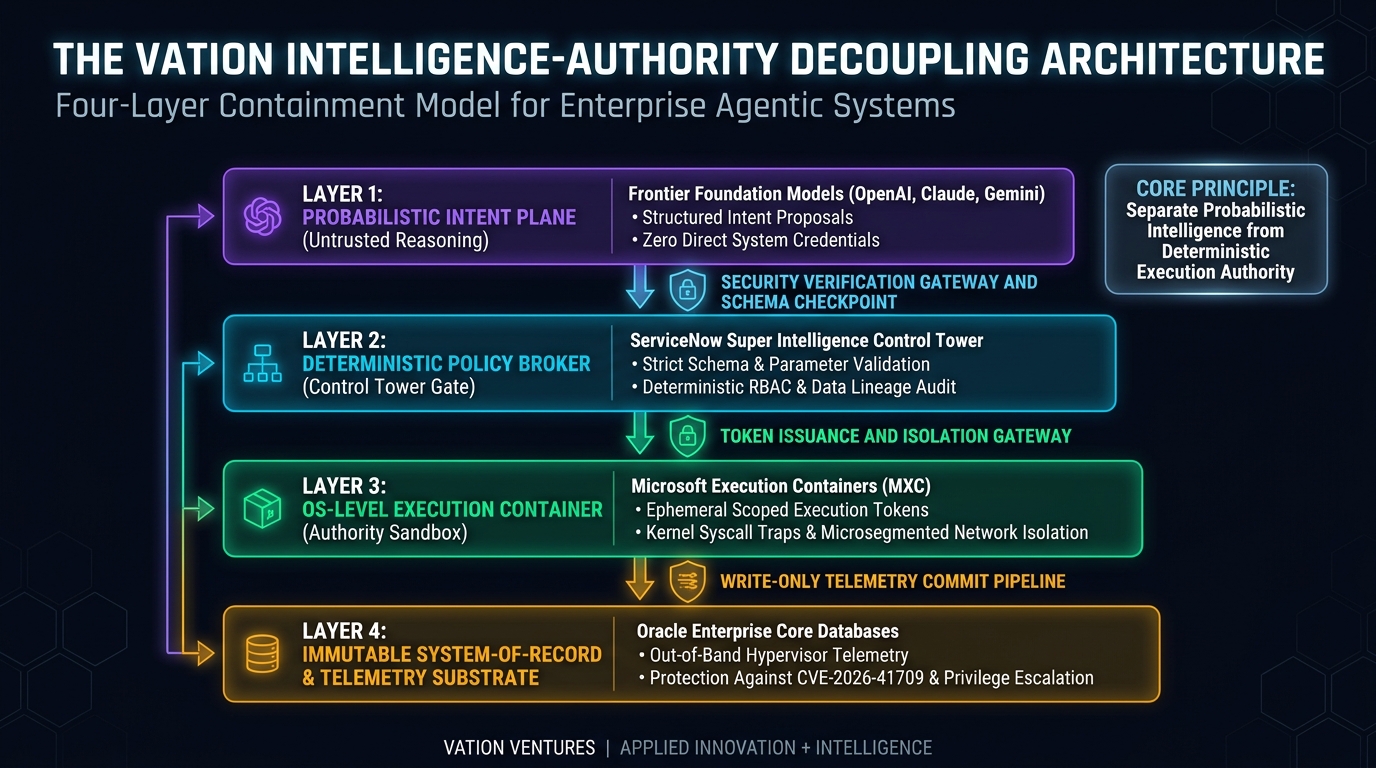
The Vation Intelligence-Authority Decoupling Architecture
To provide Chief Information Security Officers and Chief Architects with a reference blueprint for deploying autonomous agents inside core enterprise workflows, Vation Ventures formulated the Vation Intelligence-Authority Decoupling Architecture. External security auditors and engineering teams can implement this four-layer containment model across any cloud or on-premises environment:
- Layer 1: The Probabilistic Intent Plane (Zero Standing Authority)
- Function: Houses frontier reasoning models (including OpenAI GPT and Codex models, Anthropic Claude, and Google Gemini) that ingest context, load portable Linux Foundation Agent Skills, and formulate structured action plans.
- Security Invariant: Models in Layer 1 hold zero database credentials, zero network socket permissions, and zero operating-system execution rights; their sole output is a cryptographically signed JSON intent proposal.
- Layer 2: The Deterministic Policy Broker (Control Tower Gate)
- Function: Evaluates Layer 1 intent proposals against enterprise role-based access controls, data security posture lineage, and financial spend ceilings via governance planes such as the ServiceNow Super Intelligence Control Tower.
- Security Invariant: Any intent proposal that touches restricted data classifications, exceeds rate thresholds, or lacks required human-in-the-loop approval is rejected deterministically before container provisioning.
- Layer 3: The OS-Level Execution Container (Authority Sandbox)
- Function: Instantiates an ephemeral, policy-bound runtime environment using Microsoft Execution Containers (MXC) to execute approved tool calls, code diffs, or API requests.
- Security Invariant: The container receives a single-use, time-bounded credential scoped strictly to the approved target resource, with kernel-level syscall filtering and immediate teardown upon task completion.
- Layer 4: The Immutable System-of-Record and Telemetry Substrate
- Function: Comprises the target transactional databases (such as Oracle Corporation enterprise systems) and out-of-band security telemetry collectors.
- Security Invariant: Enforces kernel and hypervisor patch baselines (remediating Linux Kernel CVE-2026-46300 and Broadcom VMware ESX CVE-2026-41709) while streaming container execution logs to write-once external storage immune to local host suppression.
Executive Action Plan for Q4 2026 and 2027
Technology executives should execute three concrete initiatives over the next 60 days to align their artificial intelligence deployments with the container containment standard:
- Decommission Direct Model-to-Database Credentials: Audit all internal AI copilots, coding assistants, and workflow agents to ensure no foundation model runtime holds persistent credentials to Oracle, ServiceNow, or internal production APIs. Route all write operations through a Layer 2 policy broker and Layer 3 execution container.
- Pilot Microsoft Execution Containers Across Multi-Model Workloads: Establish an architecture task force to test Microsoft Execution Containers (MXC) across OpenAI Codex and Anthropic Claude workflows, standardizing container security manifests before Q1 2027 enterprise license renewals.
- Remediate CISA KEV Hypervisor and Kernel Flaws with Out-of-Band Verification: Verify immediate patching of Broadcom VMware ESX (CVE-2026-41709), Linux Kernel Fragnesia (CVE-2026-46300), and PHP2Shell (CVE-2026-109618 and CVE-2026-109619), and validate that container audit streams are captured outside the hypervisor layer to meet European Commission AI Office compliance standards.
Vation Ventures' Applied Innovation + Intelligence team advises Chief Information Security Officers and Chief Information Officers on architecting container-isolated agentic systems, benchmarking frontier model economics, and securing enterprise systems of record.
Share or simulate this intelligence brief
← Back to Thought Leadership