6G Wireless Connectivity & Communication
In the evolution of network infrastructure, 6G represents the next frontier beyond 5G, promising unprecedented performance and transformative capabilities
Test the strategic choices, STEEP drivers, and regional contagion paths from this brief inside the Scenario Decision Emulator or the 3D Global Signal Map.
The Road to 6G & The Innovations Transforming Wireless Technology
In the evolution of mobile networks, 6G represents the next frontier beyond 5G, promising unprecedented performance and transformative capabilities. Although not expected until the early 2030s, 6G represents something far more than just faster connections and lower latency; it represents a convergence of communication, computing, and sensing, enabling new applications like truly immersive extended reality (XR), high-fidelity holographic telepresence, autonomous systems control, and ubiquitous intelligence embedded in the network.
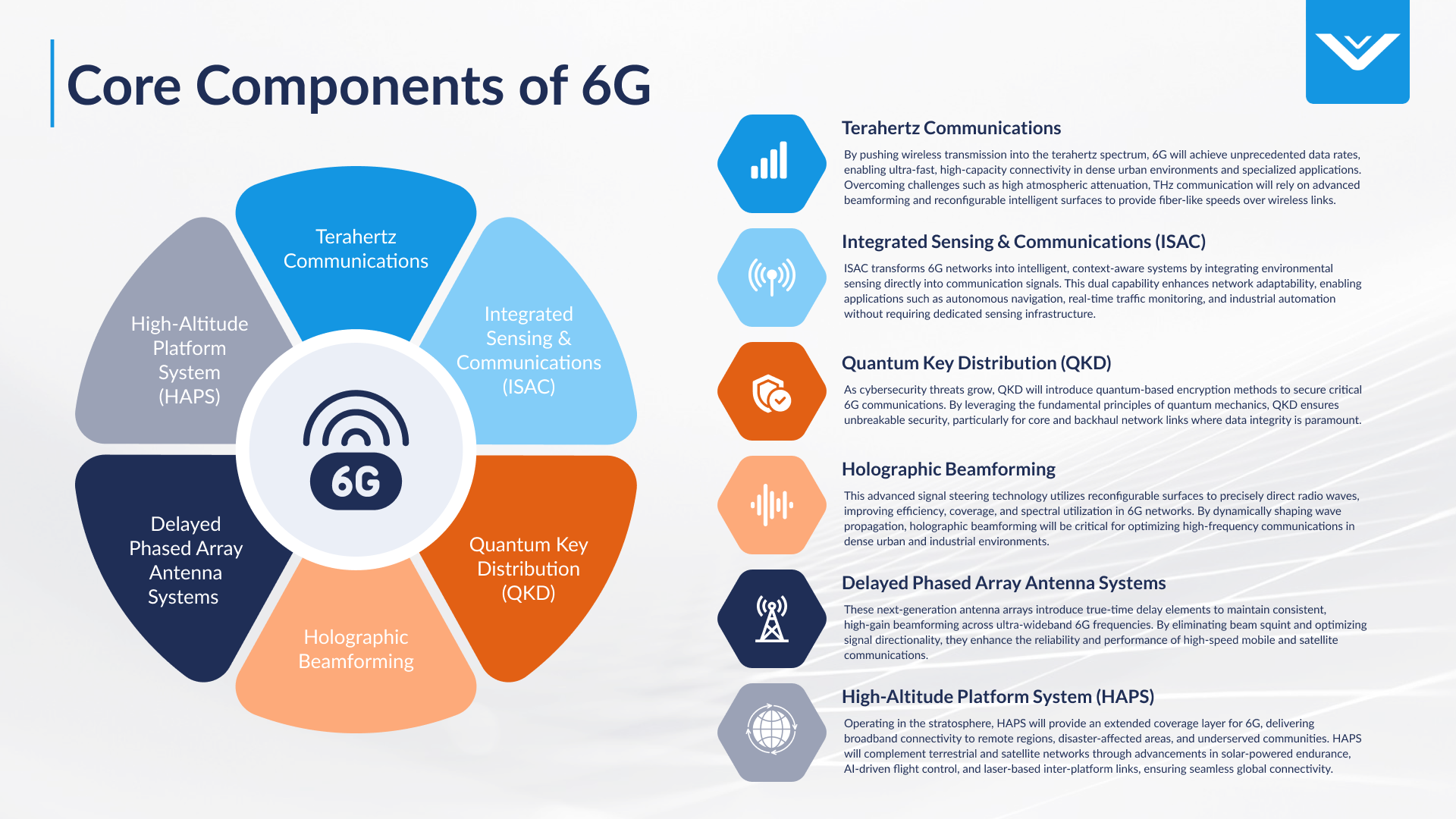
Terahertz (THz) Communications
THz waves offer enormous bandwidth for next-generation wireless communication, enabling data rates significantly higher than current networks. In 6G, THz communication will serve as a high-capacity, ultra-low-latency data layer in dense urban areas, data centers, and specialized environments requiring extreme bandwidth.
Integrated Sensing & Communications (ISAC)
ISAC transforms 6G networks into intelligent, context-aware systems by integrating environmental sensing directly into communication signals. Smart cities will benefit from ISAC-powered traffic monitoring and public safety enhancements, while industrial automation will leverage ISAC for precise robotics coordination.
Quantum Key Distribution (QKD)
As cybersecurity threats grow, QKD will introduce quantum-based encryption methods to secure critical 6G communications. By leveraging the fundamental principles of quantum mechanics, QKD ensures unbreakable security, particularly for core and backhaul network links where data integrity is paramount.
Holographic Beamforming
Holographic beamforming uses specialized reconfigurable surfaces to precisely control and direct radio waves, enhancing signal quality and reducing hardware complexity, power consumption, and interference, leading to faster and more reliable connections.
High Altitude Platform Systems (HAPS)
HAPS consist of stratospheric drones, balloons, or airships that serve as aerial base stations, providing connectivity over wide geographic areas and delivering broadband services to remote regions, disaster-stricken areas, and underserved communities.
Conclusion
The road to 6G is paved with a constellation of advanced technologies — each addressing different challenges and pushing the boundaries of what wireless networks can do. Enterprises that proactively and strategically understand and leverage these technological advances will spearhead new industry paradigms in the 6G era.
Share or simulate this intelligence brief
← Back to Thought Leadership