
Portkey
MCP and AI control plane, centralizing governance, observability, and policy enforcement across agentic workflows
The Enterprise Control Plane for AI: A Deep Dive into Portkey
As AI adoption accelerates across enterprise environments, organizations face a critical operational challenge: the fragmentation of Large Language Models (LLMs), agent frameworks, and Model Context Protocol (MCP) tooling. This fragmentation can lead to inconsistent controls, limited observability, and elevated security risks. To mitigate this chaos, enterprises need a durable operations substrate to secure and standardize their AI operations.
Core Functionality: Securing the AI Execution Chain
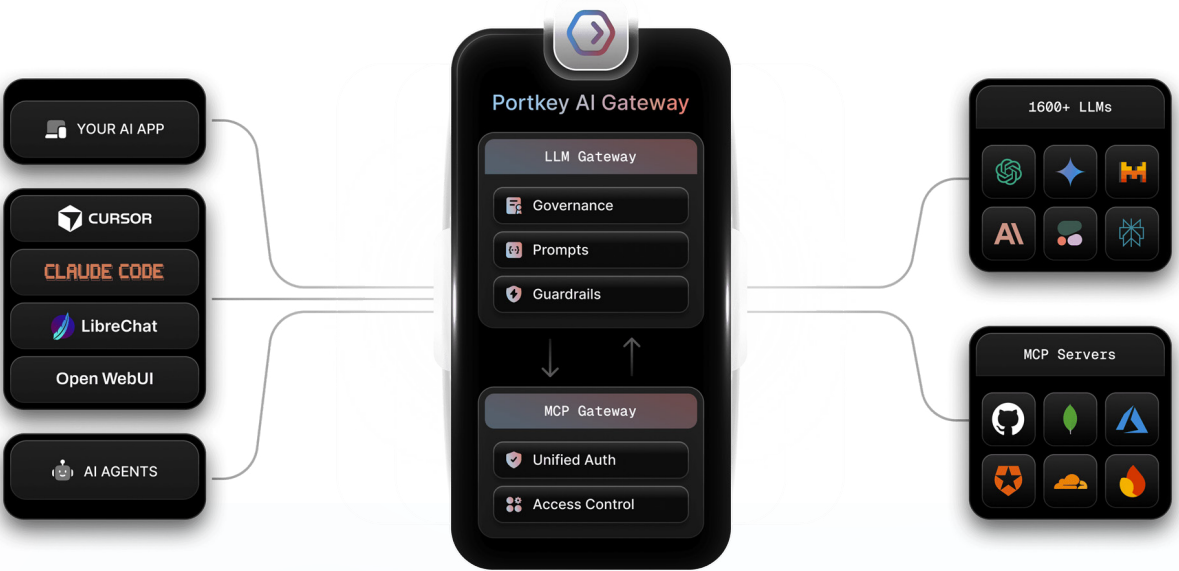
Portkey is an enterprise-grade AI control plane designed to centralize governance, observability, and enforcement across LLMs, MCP servers, and agent-driven workflows. Its capabilities are structured across several key pillars:
- Unified Governance & Enforcement: Portkey treats every AI interaction as a strictly governed operational event, enforcing centralized policies via Role-Based Access Control (RBAC), API key scoping, and compliance-grade audit logging across both human and non-human identities.
- Dynamic Routing & Telemetry Intelligence: Portkey dynamically routes LLM and tool traffic based on real-time telemetry, evaluating latency, error rates, cost thresholds, health checks, and regional availability to optimize traffic continuously.
- Active Threat Defense & Guardrails: Portkey combines preventive and detective controls, deploying network-level guardrails to block real-time adversarial attacks, prompt injections, and PII leakage.
- Agent Constraint & Invocation Control: Portkey acts as the authoritative gatekeeper for agent behavior, strictly dictating which tools and models an agent is permitted to invoke, under what conditions, and with what level of audibility.
The Value Proposition: Normalizing AI Traffic at Scale
The fundamental value of Portkey is its ability to abstract the complexity of multiple AI providers behind a single, unified invocation layer. By unifying LLM interactions and MCP tool access, Portkey dramatically reduces enterprise fragmentation and standardizes how AI is accessed, monitored, and controlled across teams.
Conclusion
For enterprises rapidly expanding their use of LLMs, AI agents, and internal tools, a fragmented approach to security and routing is no longer viable. Portkey offers a holistic, strategically aligned solution to serve as an enterprise's foundational AI governance backbone, keeping agentic workflows fast, cost-effective, and fully secure.
Share this innovator profile
← Back to Innovator Illumination